
AI Engineering
The Future of AI-Enabled ERP Systems
A practical view of how governed AI agents, trusted enterprise data, and human oversight will reshape ERP without weakening financial and operational control.
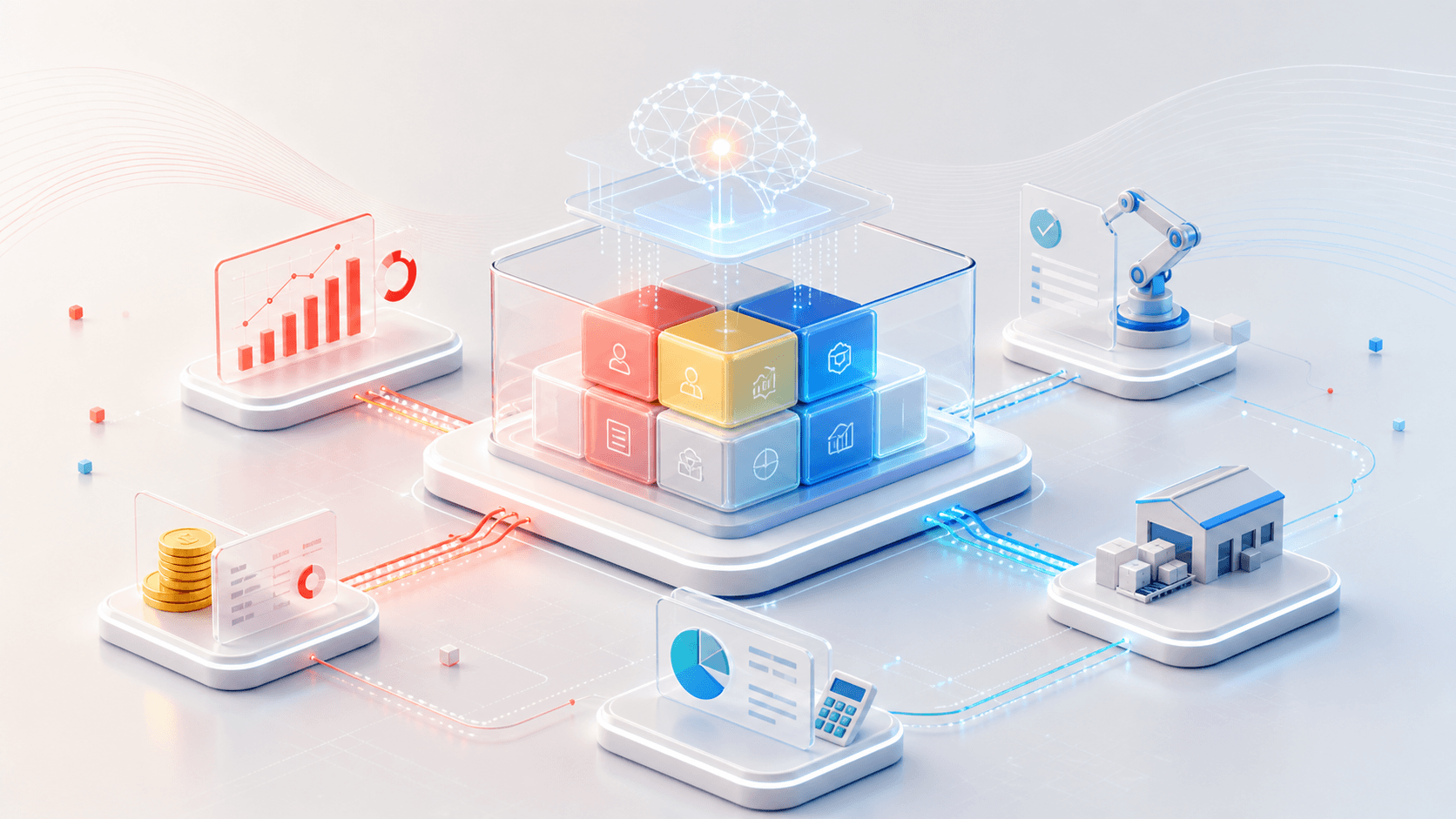
Loading insight...
A practical view of how governed AI agents, trusted enterprise data, and human oversight will reshape ERP without weakening financial and operational control.
Enterprise resource planning is entering a new phase. The traditional ERP mandate—record transactions, enforce controls, and produce a reliable system of record—remains essential. What is changing is the layer around that core: AI can now interpret context, surface exceptions, recommend actions, and coordinate work across finance, supply chain, projects, service, and connected applications.
The important question is therefore not whether an ERP platform has an AI assistant. It is whether the organization can use AI to improve decisions and execution without weakening data integrity, accountability, or operational control.
The likely future is neither a fully autonomous ERP nor a conversational interface placed over unchanged processes. It is a governed operating model in which deterministic business rules protect the ledger and critical transactions, while probabilistic AI helps people understand situations, prioritize work, and automate bounded tasks.
AI-enabled ERP combines enterprise resource planning data and business rules with machine learning, generative AI, and task-oriented agents. Its strongest use cases are exception detection, grounded analysis, recommendations, and bounded workflow automation. Successful adoption depends on trusted data, role-based access, human oversight, auditability, and measurable business outcomes—not on unrestricted autonomy.
Conventional ERP workflows wait for a user to open a module, inspect a report, identify a problem, and initiate the next step. AI-enabled ERP reverses part of that interaction. The system can continuously evaluate operational signals and bring the most relevant exception or decision to the responsible person.
Current product direction supports this shift:
These implementations differ, but they point to the same architectural change: AI is moving from a separate analytics tool into the flow of operational work. That is meaningful because ERP value is created at decision points—whether to release an order, challenge an invoice, adjust a forecast, contact a customer, or escalate an exception—not simply when a dashboard is viewed.
The most credible opportunities share three characteristics: the task occurs frequently, the required context exists in trusted systems, and the outcome can be measured.
AI can summarize overdue accounts, compare payment behaviour, explain variances, match supporting documents, and propose collection or reconciliation actions. The model should not redefine accounting policy or post an unsupported journal entry. Its value is reducing the time between an exception appearing and a qualified person resolving it.
Demand, inventory, supplier, logistics, and external-risk signals can be combined to identify shortages or delays earlier. AI can explain the likely impact, rank affected orders, and prepare response options. The planner remains accountable for trade-offs involving service levels, cost, capacity, and contractual commitments.
Conversational access can make ERP information available to more employees, but a language model should not invent the meaning of revenue, margin, available inventory, or on-time delivery. Those definitions must come from governed metrics, dimensional models, master data, and role-based permissions. Natural language is the interface; the enterprise semantic model remains the authority.
Agents are useful when they operate within an explicit process boundary—for example, collecting missing invoice information, preparing a purchase requisition, drafting a customer response, or routing an approval. Each action should use approved tools, respect the user's permissions, produce an audit trail, and escalate when confidence or policy conditions are not met.
ERP histories contain evidence about bottlenecks, rework, overrides, and recurring exceptions. AI can help identify these patterns and propose process improvements. This is more valuable than automating a poorly designed workflow: first reveal why the process fails, then decide what should be standardized, redesigned, or automated.
AI does not repair weak ERP foundations. It amplifies them. Fragmented master data, inconsistent process ownership, excessive privileges, and undocumented integrations become more dangerous when an agent can act at machine speed.
A production-ready architecture should separate five concerns:
This separation preserves a crucial boundary: an AI output is not automatically a business fact, and a proposed action is not automatically an authorized transaction.
ERP decisions can affect financial reporting, employees, suppliers, customers, and regulatory obligations. Governance cannot be added after a pilot succeeds.
The NIST AI Risk Management Framework organizes AI risk work around four continuous functions: govern, map, measure, and manage. Applied to ERP, that means defining ownership and acceptable use, mapping each AI use case to business impact, measuring quality and failure modes, and managing controls throughout the lifecycle. The OECD AI Principles reinforce transparency, robustness, human oversight, traceability, and accountability.
In practical terms, an AI-enabled ERP capability should have:
Human oversight should be risk-based. Requiring approval for every low-impact draft destroys value; allowing autonomous high-impact postings creates unacceptable exposure. The control should match the consequence of error.
Organizations should resist buying a broad promise of “autonomous ERP.” A staged approach produces better evidence and less operational risk.
Start with read-only or draft capabilities: summarize an account, explain a variance, retrieve a policy, or prepare a response. Measure time saved, answer quality, user adoption, and correction rates.
Allow AI to prioritize exceptions and propose next-best actions, but require a qualified user to decide. Measure decision quality, resolution time, working-capital impact, service levels, and false positives.
Let the agent assemble and validate a transaction or workflow step, then route it through existing authorization controls. Measure straight-through processing, rework, control exceptions, and auditability.
Only after sufficient evidence should low-risk, reversible, high-volume actions execute automatically. Maintain thresholds, monitoring, sampling, and an immediate fallback to human handling.
This progression makes the business case observable. It also distinguishes a useful production capability from an impressive demonstration.
The return on AI-enabled ERP should be expressed in operational measures, not the number of copilots deployed. Useful metrics include:
Every measure needs a baseline and a counterfactual. If a process improves after deployment, leaders should still ask whether the gain came from AI, cleaner data, redesigned workflow, or increased management attention. Often the strongest result comes from all four—and the architecture should make those contributions visible.
The future of ERP will be less about navigating modules and more about managing outcomes across connected processes. Specialized agents will monitor events, assemble context, and coordinate bounded tasks. People will spend less time locating records and more time resolving ambiguity, setting policy, managing relationships, and making accountable trade-offs.
But ERP will not become valuable merely because it can converse. Competitive advantage will come from the quality of an organization's process design, data semantics, controls, integrations, and ability to learn from operational outcomes. Models will become more capable and increasingly interchangeable; trusted enterprise context and disciplined execution will remain difficult to copy.
The professional position is therefore balanced: AI should extend ERP control, not bypass it. Organizations that combine stable transaction systems with governed intelligence can move from retrospective reporting toward earlier intervention and better decisions. Those that automate before establishing data and accountability may simply make errors faster.
An AI-enabled ERP system combines authoritative enterprise transactions and rules with AI capabilities that interpret data, identify exceptions, generate explanations, recommend decisions, or perform approved workflow steps.
No. AI does not replace the need for ledgers, master data, posting rules, permissions, approvals, and audit trails. It adds a reasoning and interaction layer around those deterministic controls.
Strong early use cases include account summaries, variance analysis, reconciliation support, collections prioritization, document matching, demand and inventory exceptions, policy retrieval, and preparation of approval-ready transactions.
They can execute explicitly permitted actions, but material or irreversible transactions should retain validation, segregation of duties, approval thresholds, and full audit evidence. Autonomy should match the consequence of error.
Start with one high-volume, measurable process using read-only assistance or draft recommendations. Establish a baseline, test quality and risk, monitor corrections, and expand authority only after production evidence supports it.